Basics
What is a perp?
A perpetual future tracks a price with no expiry date, using funding instead of settlement to stay anchored.

A perp (short for perpetual future) is a derivative contract that tracks the price of something without ever expiring. You can go long if you think the price will rise or short if you think it will fall, usually with leverage, and you hold the position for as long as you like. Instead of settling on a fixed date, a perp uses periodic funding payments between longs and shorts to keep its trading price close to the underlying price.
That one design choice, no expiry plus funding, is why perps became the dominant way to trade crypto with leverage. They give you exposure to a price move without owning the asset, without rolling contracts every month, and with the same ease of going short as going long.
What "perpetual" means
A traditional futures contract has an expiry date. On that date it settles against the price of the underlying, so as expiry approaches the futures price converges to the spot price. If you want to keep your exposure, you close the expiring contract and open the next one, which is called rolling.
A perpetual future removes the expiry. There is no settlement date forcing the price back to the underlying, so the contract needs another anchor. That anchor is funding. The word "perpetual" just means the contract can stay open indefinitely: your position lasts until you close it, or until you are liquidated.
Funding: the anchor that replaces expiry
Funding is a periodic payment between the two sides of the market. It compares the perp's trading price with a reference price (an index or mark price) and charges whichever side is pushing the perp away from it.
- When the perp trades above the reference, longs pay shorts. Holding a long gets more expensive and holding a short gets paid, which pulls the price down.
- When the perp trades below the reference, shorts pay longs, which pulls the price up.
Funding is paid between traders, not to the exchange. It accrues while your position is open, so it is a real cost or income on top of your price PnL. The full mechanics, including how the rate is calculated, are in Funding rates explained.
Leverage, long and short
Perps are margined products. You post collateral as margin and control a position whose notional value is larger than that collateral. At 5× leverage, $200 of margin controls $1,000 of exposure.
Leverage scales gains and losses by the same factor. A 10% move in your favour is a 50% gain on your margin at 5×; a 10% move against you is a 50% loss. If losses eat your margin down to the maintenance margin, the position is liquidated. Leverage and liquidation works through the math.
Going short is as simple as going long: you open a position that profits when the price falls. There is no borrowing step as there is with shorting a stock. Long vs short compares the two sides in detail.
A worked example
Here is a perp trade on a simple price, with round numbers.
During the trade you would also pay or receive funding. If the perp traded above the reference price the whole time, your long would pay a small amount each funding interval; if it traded below, you would collect.
How perps compare to spot and dated futures
| Spot | Dated future | Perp | |
|---|---|---|---|
| Expiry | None, you own the asset | Fixed date | None |
| Leverage | Usually none | Yes | Yes |
| Easy to short | No | Yes | Yes |
| What keeps price anchored | It is the price | Convergence at expiry | Funding payments |
There is more on the trade-offs in Perps vs spot vs futures.
Perps on prediction markets
Most perps track an asset price, such as a coin or an index. A perp can track any price that has a reliable reference, including the implied probability of a real-world event.
On a prediction market, the price of an outcome sits between 0 and 1 and reads as a probability: a price of 0.62 means the market puts the odds at 62%. A perp on that price lets you go long if you think the probability is too low, or short if you think it is too high, with leverage and without waiting for the event to finish. Because the price is bounded between 0 and 1, a probability perp behaves differently near the edges, and the event's resolution gives the market a natural end. Perps on prediction markets covers those differences, and Implied probability explains how to read the price.
How Perp.com fits
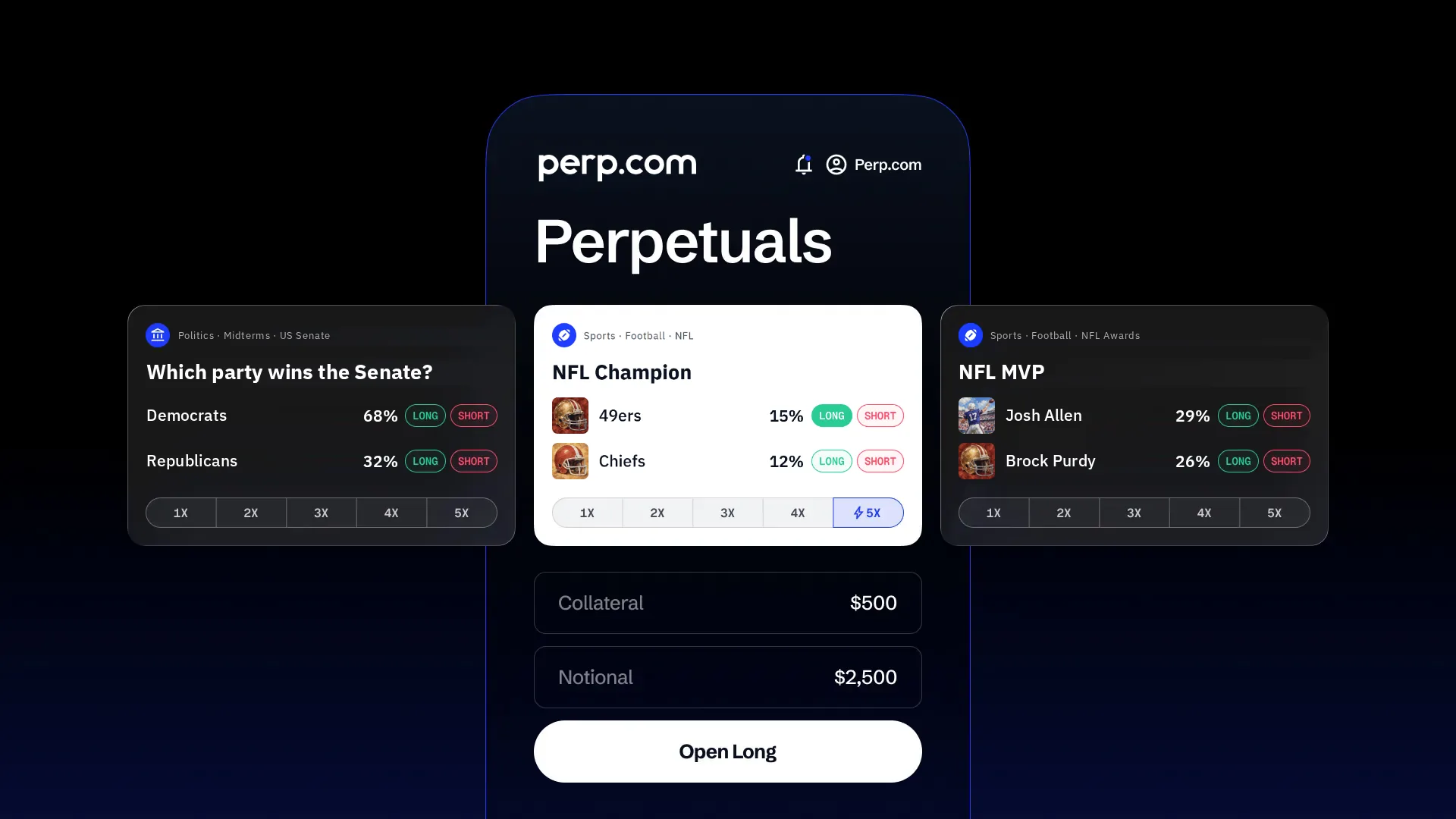
Perp.com offers perpetual futures on the probability of real-world events: elections, macro prints, sports and culture. Each market's price is the implied probability of one outcome, between 0 and 1. You can go long or short with leverage from 1× to 5×, using cross or isolated margin, and there is no expiry: a position stays open until you close it or the event resolves.
A few specifics:
- Collateral is USDC, held on-chain. Fills are matched off-chain and settled on-chain on HyperEVM.
- The mark price comes from Polymarket's odds for the same outcome, passed through a guard pipeline. Margin, PnL and liquidation use the mark, not the last trade. See Oracle and mark price.
- Funding keeps the trading price near the mark. When the book trades above the mark, longs pay shorts; below it, shorts pay longs.
- Resolution replaces expiry as the natural end. When the event resolves, the market enters a settling window, trading becomes reduce-only, the mark moves gradually toward 0 or 1, and remaining positions close at the final mark.
Perp.com is in closed beta and is not publicly live yet. You can read the docs, browse the markets, or apply through the closed beta.
Key takeaways
FAQ
- What does perp mean in trading?
- Perp is short for perpetual future, a futures contract with no expiry date. It tracks the price of an underlying, lets you go long or short with leverage, and uses periodic funding payments to stay close to the underlying price.
- What is the difference between a perpetual future and a regular future?
- A regular future expires on a set date and settles against the underlying, which pulls its price into line. A perpetual future never expires, so it uses funding payments between longs and shorts to keep its price anchored instead.
- Can you lose more than you put in on a perp?
- Your position is liquidated when your equity falls to the maintenance margin, which is designed to close it before your margin is gone. Fast moves can still cause losses beyond that point, which exchanges cover with mechanisms like auto-deleveraging and an insurance fund. Leverage amplifies losses as well as gains.
- Do perps ever expire?
- No. A perp stays open until you close it or it is liquidated. On Perp.com, where each market tracks the probability of an event, the event's resolution is the natural end: the market settles and remaining positions close at the final mark.