Prediction markets
Perps on prediction markets
Trade the probability of an event like a perpetual: long or short, with leverage and no expiry.
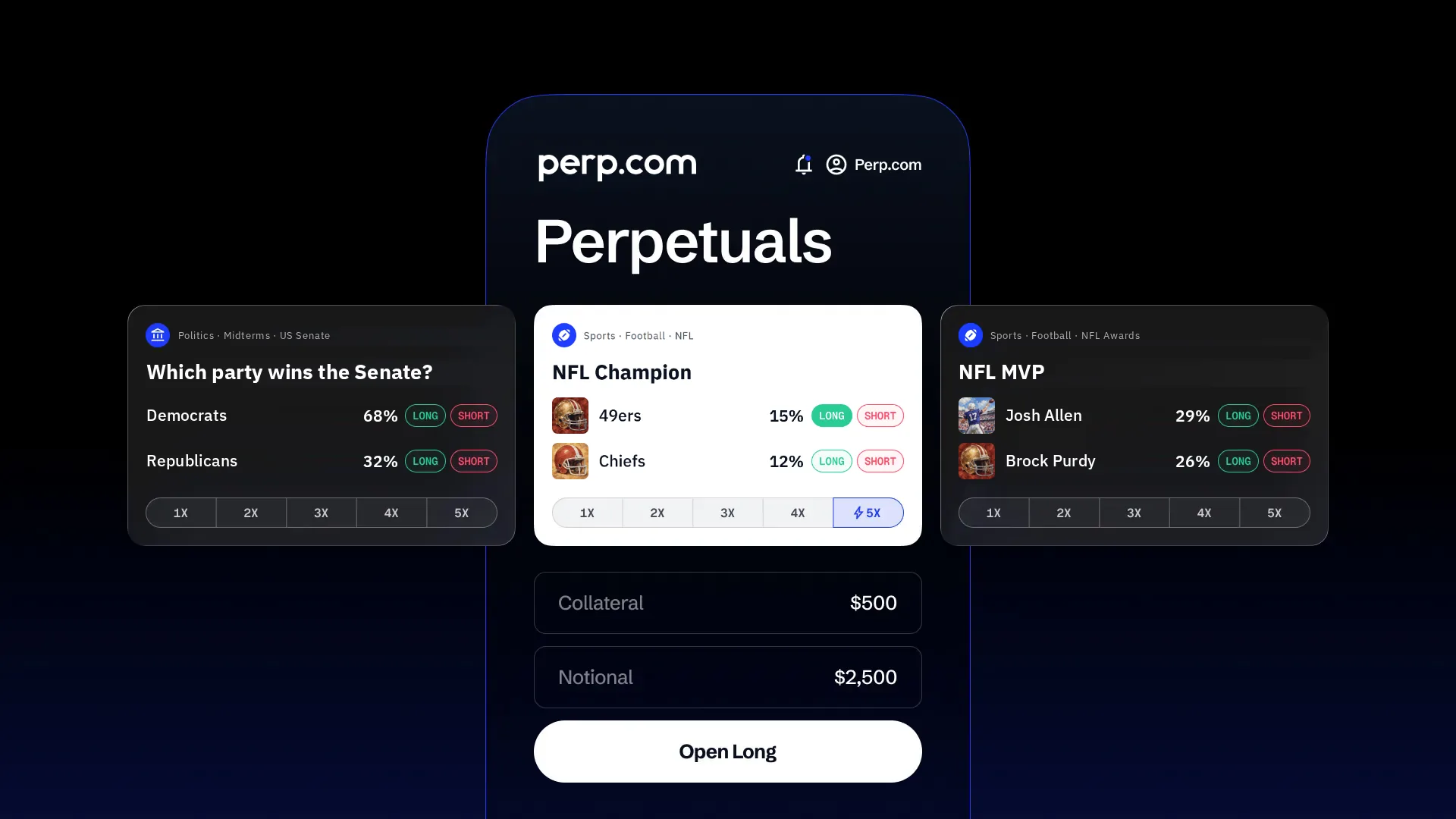
A perp on a prediction market is a perpetual future whose price is the probability of a real-world event. Instead of buying YES shares and locking up the full price until the event resolves, you post margin and go long or short the probability itself, with leverage and no expiry. On Perp.com, the price tracks Polymarket's odds for the same outcome, and leverage runs from 1× to 5×.
That changes what a prediction-market view can do. You can size a position without paying for it in full, bet against an outcome by shorting, and take profit when the odds move rather than waiting months for the final answer. It also adds what leverage always adds: the chance of being liquidated before you are proven right.
Why prediction markets never had leverage
A prediction-market share is a simple contract. A YES share in an outcome pays $1 if it happens and $0 if it doesn't, so its price is the market's implied probability. Two features of that design have kept leverage out.
- Capital is locked until resolution. A YES share bought at 40¢ ties up 40¢ until the event resolves, which can be weeks or months away. Every share is fully paid: the YES and NO sides together put up the $1 that the winner collects.
- The payoff is bounded and can jump. The price lives between 0 and 1, and news can move it from 40% to 95% in minutes. A lender offering leverage on shares would need to close positions faster than the price can gap, and without a reliable price feed and a liquidation engine, there is no safe way to do that.
So on a share market, the only way to bet bigger is to bring more capital, and the only way to bet against an outcome is to buy the other side.
How a perp on a probability works
On Perp.com, each market is one event outcome, and its price is the implied probability of that outcome, between 0 and 1. It is shown as 0–100% or 0–100¢.
- Go long if you think the probability is too low. You profit as it rises.
- Go short if you think it is too high. You profit as it falls.
Your profit or loss is your position size times the change in price. You don't need the event to resolve to realise it: if the probability moves from 40% to 55% next week, you can close and take the difference. There is no expiry, so a position stays open until you close it or the event resolves. You can trade with cross or isolated margin, and collateral is USDC held on-chain, with fills matched off-chain and settled on-chain on HyperEVM.
Where the price comes from
Two prices matter on any perp: the price the order book trades at, and the mark price the risk system uses. On Perp.com, the mark comes from Polymarket's odds for the same outcome. Before anything uses it, the raw feed passes through a guard pipeline:
- Probability bounds keep the mark strictly between 0 and 1 while the market is live, because a price sitting exactly at 0 or 1 would make the leverage math break down.
- A deviation clamp limits how far the mark can move in a single update, which rejects spikes and manipulation attempts.
- Smoothing averages the recent feed so per-tick jitter doesn't move margin.
- A staleness check flags the feed if it stops updating, and the protocol falls back rather than marking on old data.
Margin, profit and loss, and liquidation all use the mark, not the last trade. A single thin print on the order book can't trigger a liquidation or let a distressed position dodge one. The oracle docs describe each guard in detail.
Funding keeps the book near the odds
The order book is free to trade away from the mark, so something has to pull it back. That is funding. When the book trades above the mark, longs pay shorts; when it trades below, shorts pay longs. The payment makes the crowded side more expensive to hold, which pushes the trading price back toward the probability the oracle reads.
The baseline funding interval is 8 hours, scaled per market, shorter for events that resolve within a day. The rate is capped so funding alone can't push a position into liquidation. Funding rates explained covers the calculation.
Margin that rises as the event nears
Event markets get more dangerous as they approach the answer. A probability that drifted for weeks can jump to 0 or 1 in an afternoon. Perp.com's initial margin is dynamic for that reason: it rises with a market's open interest and as the event nears resolution. Two identical orders can need different margin depending on how crowded the market is and how close it is to resolving.
Once a position is open, it is liquidated if its equity reaches the maintenance margin. Liquidation is partial and rate-limited. It executes against the order book first, then uses auto-deleveraging for any remainder, with an on-chain insurance fund as the final backstop.
What happens at resolution
A share market snaps to $1 or $0 the moment the outcome is decided. A leveraged market can't safely do that, so Perp.com uses a settling window instead.
- The event resolves and the market enters its settling window.
- The mark moves gradually from its last value toward 0 or 1, rather than gapping there in one step.
- Trading is reduce-only: you can close or shrink a position, but nobody can open new exposure.
- When the window ends, remaining positions close at the final mark and balances are released.
The trading docs show the full market lifecycle.
An example trade
The numbers below are illustrative. They assume each contract moves $1 for a full move from 0 to 1, the same as a prediction-market share, and ignore funding.
Now the other direction. If the probability falls to 32%, the perp loses 2,500 × $0.08 = $200, the whole margin, so it is liquidated before it gets there, once equity reaches maintenance margin. The shareholder is down $40 and still holds the shares, free to wait for resolution. Leverage made the gain five times larger and made the loss five times larger too.
If you thought 40% was too high, the trade flips: a short profits as the probability falls, and loses as it rises.
The risks
- Leverage cuts both ways. At 5×, a move of a few probability points can wipe out the margin behind a position. Leverage and liquidation shows where that line sits.
- Event prices jump. News can move a probability tens of points in minutes. The deviation clamp and smoothing slow the mark down; they don't stop a real move.
- You depend on the source odds. The mark follows Polymarket's price for the same outcome. If that market is thin or mispriced, so is the mark.
- Funding is a running cost. If you hold the crowded side while the book trades away from the mark, you pay.
- Late exposure costs more. Margin rises near resolution, and once the event resolves you can only reduce.
Perp.com is in closed beta and selects 15 traders a week from people who show up on its posts on X. You can see the markets and how the closed beta works.
FAQ
- Can you use leverage on Polymarket?
- Polymarket shares are fully paid: you put up the whole share price and wait for it to pay $1 or $0. Perp.com offers perpetual futures that track Polymarket's odds for the same outcome, with leverage from 1× to 5×, long or short.
- Is the perp price the same as Polymarket's price?
- Not exactly. The mark price, used for margin and profit and loss, is Polymarket's odds passed through a guard pipeline. The trading price is set by Perp.com's order book, and funding pulls it toward the mark.
- Do I have to hold until the event resolves?
- No. Your profit or loss is the change in probability, so you can close whenever the odds move. If you are still open at resolution, the market enters a settling window and your position closes at the final mark.
- What happens to my position when the event resolves?
- The market enters a settling window. The mark moves gradually toward 0 or 1, trading becomes reduce-only, and any position still open when the window ends closes at the final mark.