Basics
Perps vs spot vs futures
Three ways to trade the same price, and what each one asks of your capital.

Spot means buying the asset itself: you pay in full and you own it. A dated future is a contract to buy or sell at an agreed price on a fixed date, traded on margin. A perpetual future (a perp) is a futures contract with no expiry date: it stays open until you close it, and a periodic funding payment between longs and shorts keeps its price close to the underlying.
All three let you profit when a price moves your way. They differ in how much capital you tie up, whether you can bet on a fall as easily as a rise, what holding a position costs over time, and how it ends. This guide compares them side by side, then shows how the same three ideas map onto prediction markets, where the thing being priced is the probability of an event.
The comparison at a glance
| Spot | Dated futures | Perpetual futures | |
|---|---|---|---|
| Expiry | None: you own the asset | Fixed date (monthly, quarterly) | None |
| Leverage | 1× unless you borrow | Yes, through margin | Yes, through margin |
| Funding | None | None; price converges at expiry | Periodic payments between longs and shorts |
| Settlement | Asset and cash swap at the trade | At expiry, in cash or by delivery | No final settlement; profit and loss is marked continuously |
| Ownership | You own the asset | You hold a contract | You hold a contract |
| Shorting | Needs a borrowed asset | Native: sell the contract | Native: sell the contract |
| What anchors the price | It is the price | Convergence to spot at expiry | Funding toward an index price |
Spot: you own the thing
A spot trade is the simplest market there is. You buy 10 units of an asset at $100 each, pay $1,000, and the units are yours. If the price rises 10%, your holding is worth $1,100. If it falls 10%, it is worth $900, but nothing forces you to sell. There is no liquidation, no funding and no deadline.
The trade-offs are capital and direction. Every dollar of exposure costs a dollar. And betting on a fall is awkward: you have to borrow the asset, sell it, and buy it back later, which needs a lender and usually a fee.
Dated futures: a contract with a calendar
A dated future is an agreement to trade an asset at a set price on a set date. You don't pay the full value up front. You post margin, a fraction of the contract's notional value, which is where the leverage comes from. Going short is as easy as going long: you sell the contract instead of buying it.
The catch is the date. As expiry approaches, the futures price converges to the spot price, and on expiry the contract settles in cash or by delivery of the asset. If you want to keep your view beyond that date you have to close the expiring contract and open the next one, which is called rolling and costs fees and any price gap between the two contracts. The gap between a future's price and spot is the basis.
Dated futures suit anyone who cares about a specific date: a producer locking in a sale price for harvest, or a fund hedging a known liability.
Perpetual futures: futures without the date
A perpetual future keeps the margin, leverage and easy shorting of a future and removes the expiry. With no settlement date to drag the price back to the underlying, a perp needs another anchor, and that anchor is funding. When the perp trades above its reference price, longs pay shorts; when it trades below, shorts pay longs. The payment makes the crowded side more expensive to hold, which pulls the price back. Funding rates explained covers the mechanics.
Because nothing expires, you never roll. The costs move elsewhere: funding while you hold, and the risk of liquidation if your equity falls to the maintenance margin. What is a perp? is the longer introduction.
When each makes sense
None of these is better in general. Each suits a different job.
- Spot fits when you want to own the asset, hold for a long time, and never face a forced exit. The cost is full capital and clumsy shorting.
- Dated futures fit when the date matters: hedging a known exposure, or trading the basis between futures and spot. The cost is rolling and a hard end date.
- Perps fit when you want leverage, easy shorting and no expiry, typically for active trading or hedging without a fixed horizon. The cost is funding and liquidation risk.
Leverage cuts both ways. The same multiplier that turns a 10% move into a 50% gain turns it into a 50% loss, and leverage and liquidation explains where the forced exit sits.
How the three map onto prediction markets
A prediction market prices the chance that an event happens. On Polymarket, for example, you can buy YES shares in an outcome at 40¢. Each share pays $1 if the outcome happens and $0 if it doesn't, so 40¢ is the market's implied probability of 40%.
Buying those shares is a spot trade. You pay the full price, you own the shares, there is no leverage and no liquidation, and to bet against the outcome you buy the NO side instead. The shares also carry something like a futures expiry: they pay out at resolution, and until then your capital is locked unless you sell.
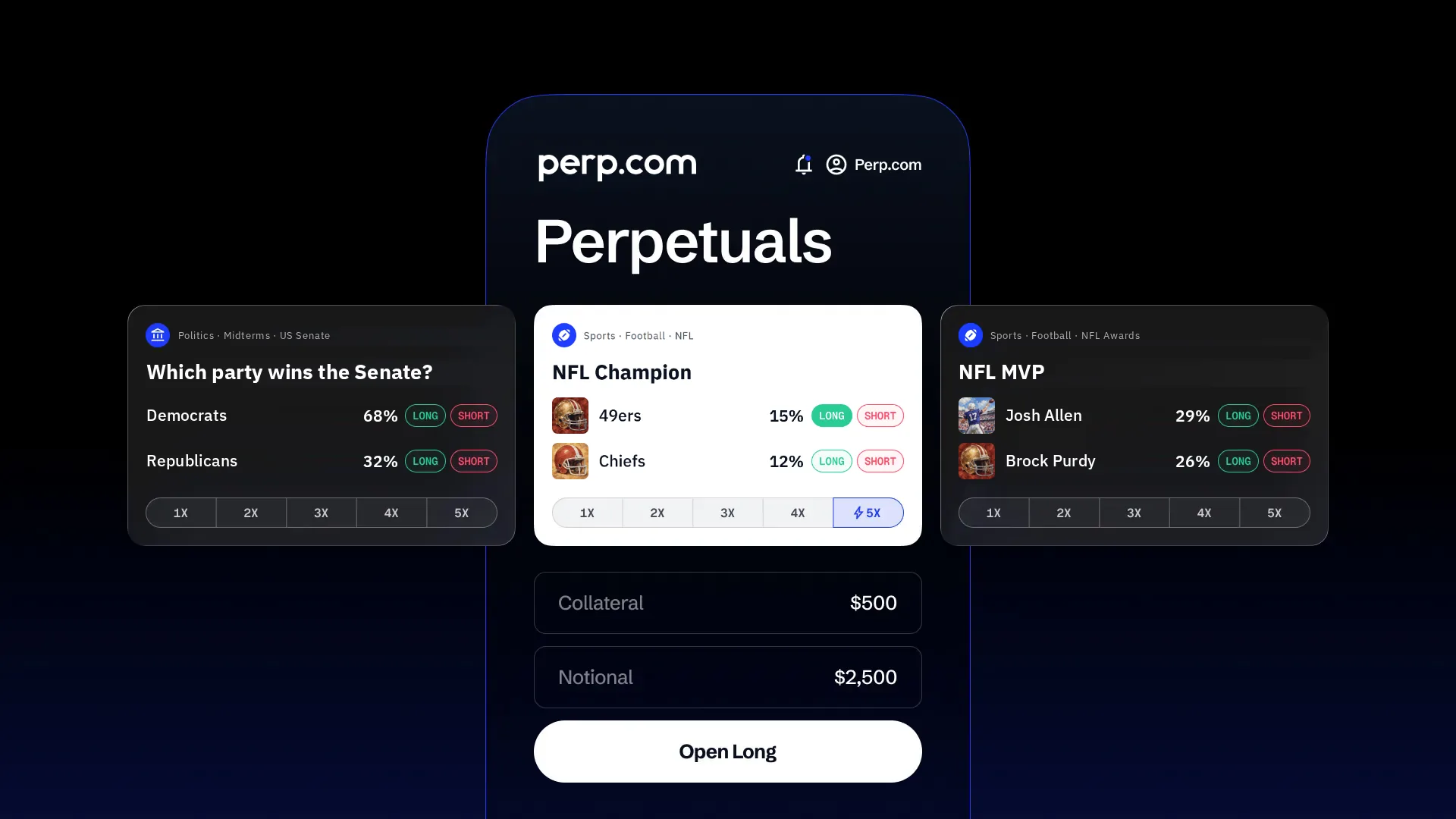
Perp.com is the perpetual version. Each market is a perpetual future on the probability of one outcome, with a price between 0 and 1 (shown as 0–100¢). You go long if you think the probability will rise and short if you think it will fall, with leverage from 1× to 5× on cross or isolated margin. There is no expiry: a position stays open until you close it or the event resolves.
| Prediction market shares | Perp.com perps | |
|---|---|---|
| What you trade | YES or NO shares in an outcome | The outcome's probability, as a price from 0 to 1 |
| Capital per $1 of exposure | $1 | As little as $0.20 at 5× |
| Betting against | Buy the NO side | Sell (short) the perp |
| Liquidation | None | When equity reaches maintenance margin |
| Funding | None | Paid between longs and shorts |
| How it ends | Shares pay $1 or $0 at resolution | Settling window, then positions close at the final mark |
The perp's mark price comes from Polymarket's odds for the same outcome, passed through a guard pipeline before it is used for margin and profit and loss. Funding keeps Perp.com's order book close to that mark. When the event resolves, the market enters a settling window in which the mark moves gradually toward 0 or 1 and trading is reduce-only. Perps on prediction markets walks through the whole lifecycle with an example trade.
FAQ
- Is a perp the same as a futures contract?
- A perp is a type of futures contract with no expiry date. It keeps the margin, leverage and easy shorting of a dated future, but replaces settlement on a fixed date with periodic funding payments that keep its price near the underlying.
- Why do perps have funding and dated futures don't?
- A dated future converges to the spot price because it settles at expiry. A perp never settles, so it needs another force to keep it near the underlying. Funding charges the side pushing the price away, which pulls it back.
- Can you be liquidated on spot?
- Not when you buy with your own money. You own the asset outright, so a price fall reduces its value but nothing forces a sale. Liquidation only applies when you trade on margin or borrow.
- Is buying YES shares on a prediction market like spot trading?
- Yes. You pay the full share price, own the shares and face no liquidation. The difference from ordinary spot is that the shares pay out $1 or $0 when the event resolves, which works like a built-in expiry.