Basics
Long vs short
The two sides of every trade, how each one pays and what shorting a probability actually means.
Going long means taking a position that profits if the price rises. Going short means taking a position that profits if the price falls. A long buys now hoping to sell higher later; a short sells now hoping to buy back lower later. Every trade on a perp has both: for each long position there is a short on the other side.
On a probability market, where the price is the odds of an event, going long means you think the probability is too low and going short means you think it is too high.
What "long" means
A long position gains value when the price goes up and loses value when it goes down. Buying a stock and holding it is the most familiar long. On a perp you do not own the underlying; you hold a contract whose PnL is your size times the price change.
What "short" means
A short position gains value when the price goes down and loses value when it goes up. Its PnL is the mirror image of a long of the same size.
In stock markets, shorting means borrowing shares, selling them, and buying them back later to return them, ideally at a lower price. That borrowing step is why shorting a stock comes with extra costs, availability limits and paperwork. On a perp there is no borrowing: you simply open a position on the sell side, and it is as easy as going long.
Payoff examples
Take a market whose price is the implied probability of an outcome. For illustration, assume one unit of position gains or loses $1 for every full move from 0 to 1, so a 0.01 move is worth $0.01 a unit. Both positions below are 1,000 units opened at 0.50, with no leverage.
| Price at exit | Long PnL | Short PnL |
|---|---|---|
| 0.00 | −$500 | +$500 |
| 0.30 | −$200 | +$200 |
| 0.50 | $0 | $0 |
| 0.70 | +$200 | −$200 |
| 1.00 | +$500 | −$500 |
The long and the short are exact mirror images before fees and funding. Whatever one gains, the other loses.
Shorting a probability
On a prediction market, the price of YES on an outcome is the market's estimate of the chance it happens. Shorting YES at 70% is, in effect, a bet that the probability will fall: that the true chance is lower than 70%, or that the market will come round to thinking so.
Shorting YES at 70% points the same way as buying NO at 30% on a prediction market: both profit if the outcome becomes less likely. The difference is in the mechanics. With a perp short you can use leverage, you pay or receive funding while the position is open, you can be liquidated, and you can close at any time against the order book. A NO share is fully paid for up front and simply pays out if NO wins. Perps on prediction markets compares the two.
One thing makes probability shorts unusual: the price cannot go above 1. On a stock, a short's potential loss has no ceiling, because the price can keep rising. On a probability, a short opened at 0.70 can lose at most 0.30 per unit before leverage. Leverage still matters, since liquidation can arrive long before the price reaches 1.
Why shorting is natural on perps
On spot markets, going short usually needs a lender. On a perp, both sides are symmetric:
- Same process. Opening a short is the same order flow as opening a long, just on the other side of the order book.
- Same margin. Both sides post margin against the same mark price and face the same liquidation rules.
- No borrow fees. There is nothing to borrow. The ongoing cost or income for either side is funding.
That symmetry is a large part of why perps are popular. If you think a price is too high, you can act on that view as directly as someone who thinks it is too low.
How funding affects each side
Funding is a periodic payment between longs and shorts that keeps a perp's trading price near its reference.
| Perp trades… | Longs | Shorts |
|---|---|---|
| Above the reference | Pay funding | Receive funding |
| Below the reference | Receive funding | Pay funding |
When one side is crowded, it tends to pay. If many traders want to be long an outcome and push the book above the mark, longs pay shorts until the gap closes. On a position held for days or weeks, funding can add up to a meaningful share of your PnL in either direction. Funding rates explained shows how it is calculated.
Risks on each side
| Risk | Long | Short |
|---|---|---|
| Worst case on a probability | Price goes to 0: lose your entry per unit | Price goes to 1: lose 1 minus your entry per unit |
| Worst case on an unbounded asset | Price goes to 0 | No ceiling on the price |
| Funding | Pays when the perp trades above the reference | Pays when the perp trades below the reference |
| Liquidation | If the price falls far enough | If the price rises far enough |
Both sides share the same core risks. Leverage magnifies losses as much as gains. Event probabilities can jump on a single headline, which can carry a leveraged position through its liquidation price quickly. And the shape of the payoff matters: a long at 0.90 can gain at most 0.10 per unit while risking 0.90, and a short at 0.10 has the same lopsided shape in reverse. Leverage and liquidation covers the math.
Long and short on Perp.com
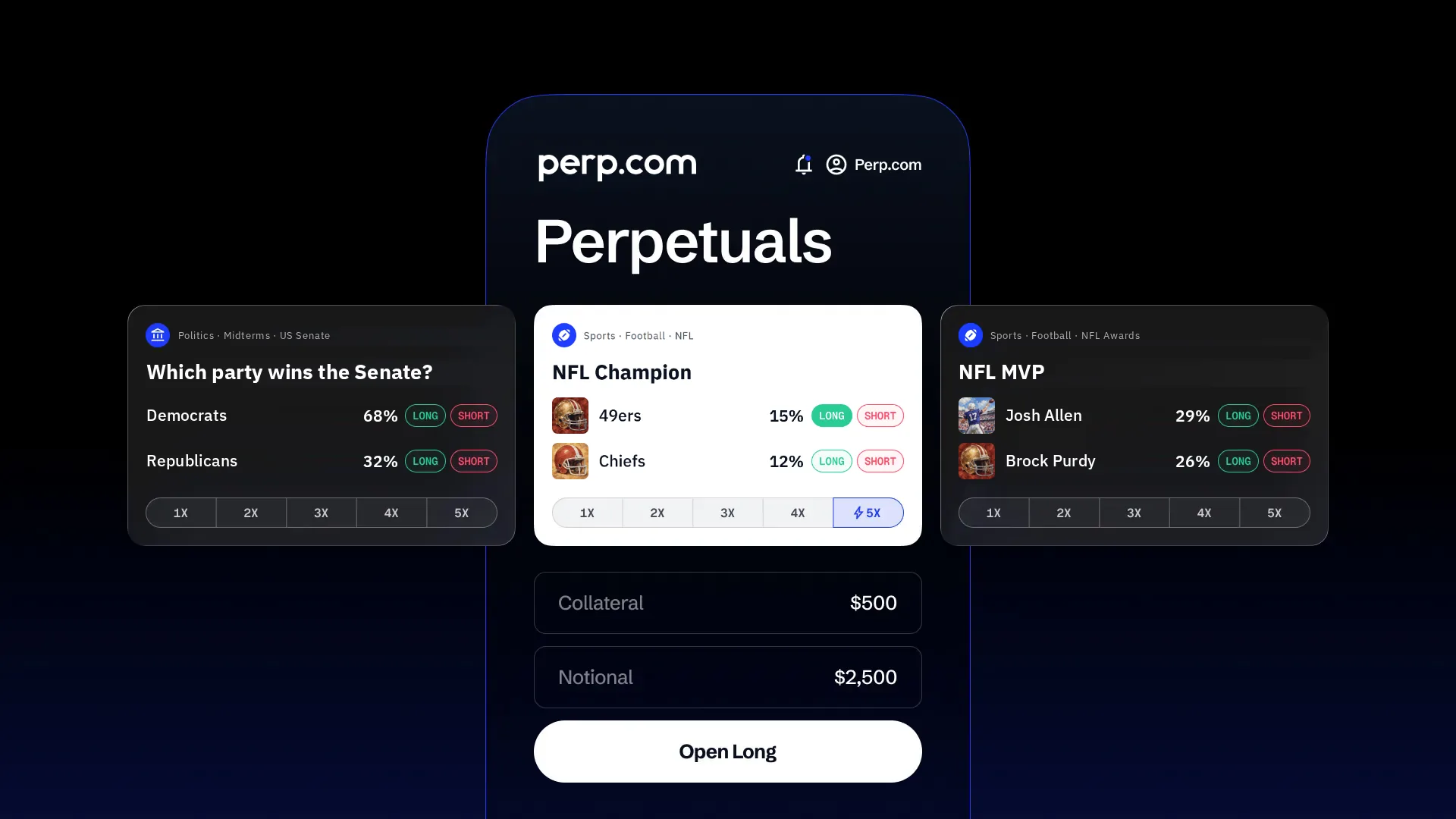
Perp.com offers perpetual futures on the probability of real-world events, where you can go long or short with leverage from 1× to 5×. A position stays open until you close it or the event resolves. Margin, PnL and liquidation use the mark price, which comes from Polymarket's odds for the same outcome after a guard pipeline. When the event resolves, trading becomes reduce-only and the mark moves gradually toward 0 or 1, so a long gains if the outcome happens and a short gains if it does not, by the gap between their entry and the final mark.
Perp.com is in closed beta and not publicly live yet. You can browse the markets, read the trading docs, or apply through the closed beta.
FAQ
- What does going long mean?
- Going long means opening a position that profits if the price rises and loses if it falls. On a probability market, going long means you think the outcome is more likely than the current price suggests.
- What does short mean in trading?
- Shorting means opening a position that profits if the price falls. In stocks it involves borrowing shares to sell; on a perp there is no borrowing, you just open a position on the sell side.
- Is shorting riskier than going long?
- On assets with no upper price limit, a short's potential loss is unlimited while a long can lose at most what the asset is worth. On a probability, the price is capped at 1, so both sides have bounded losses before leverage. With leverage, either side can be liquidated.
- Is shorting YES the same as buying NO?
- They point the same way: both profit if the outcome becomes less likely. A perp short adds leverage, funding, liquidation risk and the ability to close at any time, while a NO share is paid for in full and pays out if NO wins.