Prediction markets
Implied probability
Every price is a forecast. Here is how to read the probability inside decimal, fractional and American odds, and prediction-market cents.
Implied probability is the chance of an outcome that a price or a set of odds implies. For decimal odds it is 1 ÷ odds, so 2.50 implies 40%. For fractional odds a/b it is b ÷ (a + b), so 3/2 implies 40%. For positive American odds it is 100 ÷ (odds + 100), so +150 implies 40%; for negative American odds it is odds ÷ (odds + 100), using the number without its minus sign, so −150 implies 60%. On a prediction market the price is the probability: a share trading at 40¢ that pays $1 implies 40%.
The formulas all say the same thing: what you stake, divided by what you get back in total if you win. The sections below work through each format, show how bookmakers build a margin into their odds, and explain why market prices behave like probabilities.
The formulas at a glance
| Format | Example | Formula | Implied probability |
|---|---|---|---|
| Decimal | 2.50 | 1 ÷ 2.50 | 40% |
| Fractional | 3/2 | 2 ÷ (3 + 2) | 40% |
| American, positive | +150 | 100 ÷ (150 + 100) | 40% |
| American, negative | −150 | 150 ÷ (150 + 100) | 60% |
| Prediction market | 40¢ | 40 ÷ 100 | 40% |
Decimal odds
Decimal odds are the total amount returned per unit staked, including the stake. Odds of 2.50 mean a $10 bet returns $25 if it wins: $15 profit plus the $10 back. The implied probability is 1 ÷ decimal odds.
- 2.50 → 1 ÷ 2.50 = 0.40, or 40%
- 1.25 → 1 ÷ 1.25 = 0.80, or 80%
- 5.00 → 1 ÷ 5.00 = 0.20, or 20%
Fractional odds
Fractional odds, common in the UK and Ireland, show profit relative to stake. Odds of 5/2 mean you win $5 for every $2 staked. To convert, divide the stake side by the total: b ÷ (a + b).
- 5/2 → 2 ÷ (5 + 2) = 2 ÷ 7 ≈ 28.6%
- 1/4 → 4 ÷ (1 + 4) = 4 ÷ 5 = 80%
- Evens (1/1) → 1 ÷ 2 = 50%
American odds
American odds (also called moneyline odds) use two signs. A positive number is the profit on a $100 stake; a negative number is the stake needed to win $100.
- Positive: 100 ÷ (odds + 100). +250 → 100 ÷ 350 ≈ 28.6%.
- Negative: odds ÷ (odds + 100), ignoring the minus sign. −400 → 400 ÷ 500 = 80%.
- +100 and −100 both mean an even-money bet, 50%.
Prediction-market prices
A prediction market skips the conversion. A YES share pays $1 if the outcome happens and $0 if it doesn't, so its price in cents is its implied probability in percent. A share at 62¢ implies 62%. The matching NO share should trade near 38¢, because YES and NO together always pay exactly $1.
When the order book has a gap between the best bid and best ask, the midpoint is the usual single estimate. A YES book at 39¢ bid and 41¢ ask implies about 40%.
Converting the other way
Going from a probability p back to odds is just the reverse.
| Probability | Decimal | Fractional | American |
|---|---|---|---|
| 20% | 5.00 | 4/1 | +400 |
| 25% | 4.00 | 3/1 | +300 |
| 40% | 2.50 | 3/2 | +150 |
| 50% | 2.00 | 1/1 (evens) | +100 |
| 75% | 1.33 | 1/3 | −300 |
| 80% | 1.25 | 1/4 | −400 |
Decimal is 1 ÷ p. For American, use +100 × (1 − p) ÷ p below 50% and −100 × p ÷ (1 − p) above it.
The overround, or vig
Add up the implied probabilities of every outcome in a bookmaker's market and you will usually get more than 100%. The excess is the overround, also called the vig or juice. It is the bookmaker's margin, built into the prices.
The same method works with three or more outcomes. A football match at 2.10 home, 3.40 draw and 3.60 away implies 47.6%, 29.4% and 27.8%, which sum to 104.8%. Dividing each by 104.8 gives fair probabilities of about 45.4%, 28.1% and 26.5%. This simple proportional method is the most common; more refined methods spread the margin unevenly, since bookmakers often load more of it onto longshots.
Prediction markets have no bookmaker, but they have a version of the same thing: the spread. If YES is 39¢ bid and 41¢ ask, buying YES costs 41¢ and buying NO costs 61¢ (1 minus the YES bid). Together that is 102¢ for a guaranteed $1, and the extra 2¢ goes to whoever is providing liquidity rather than to a house.
Why market prices are probabilities
A share that pays $1 if an event happens is worth, on average, $1 times the probability of the event. If the share trades at 40¢ and you believe the true probability is 50%, buying it has a positive expected value: 0.50 × $1 − $0.40 = $0.10 per share. Traders who disagree with the price buy or sell until the price reflects what the market as a whole believes.
That is why the price is a forecast, not just a cost. It is not a perfect one. Fees, the cost of locking up capital until resolution, thin books and a well-documented tendency to overprice longshots can all pull a price away from the true chance. The gap between your estimate and the implied probability is your edge, if your estimate is better.
How Perp.com uses implied probability
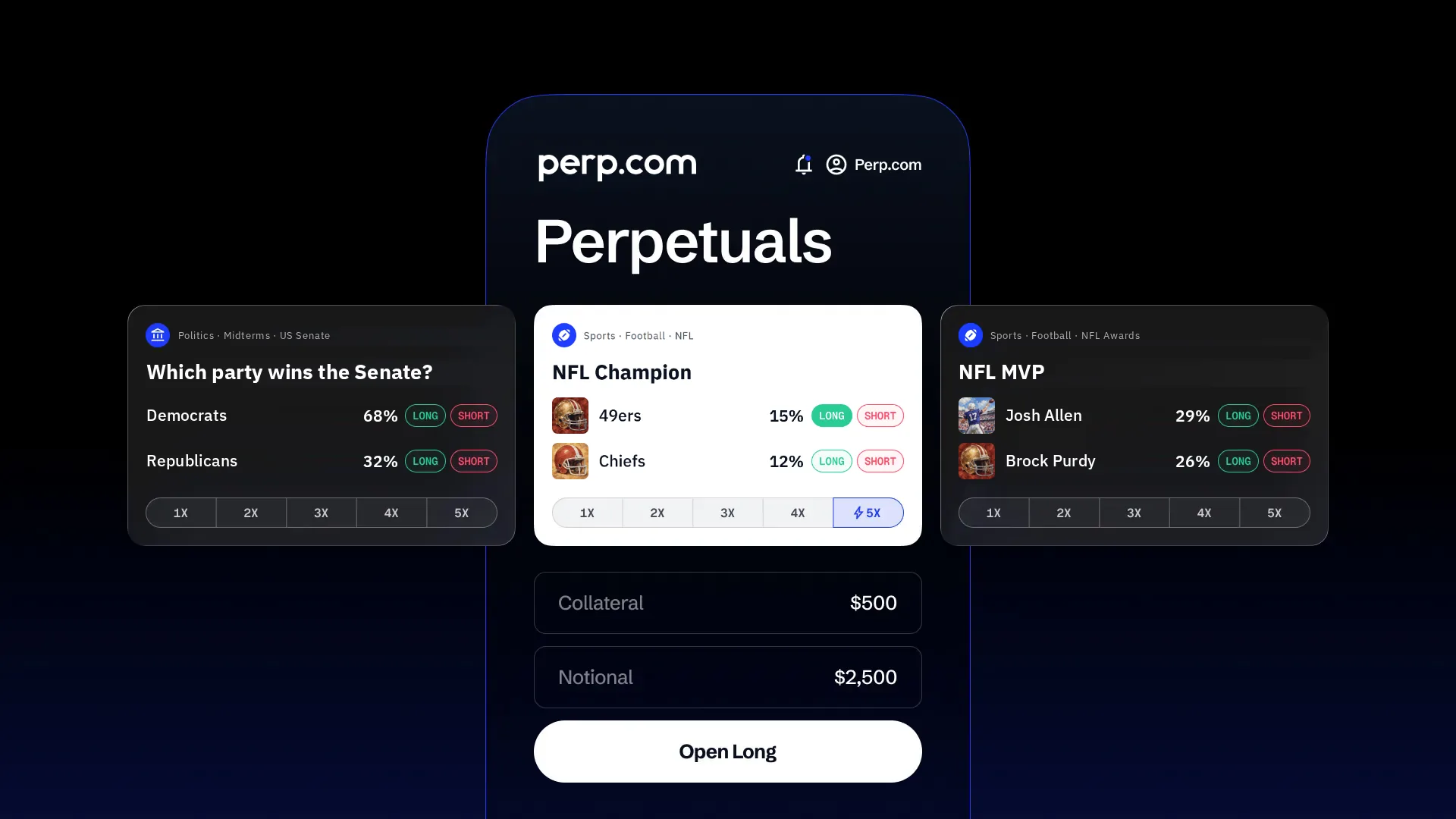
On Perp.com, implied probability is the price. Each market is a perpetual future on one outcome of a real-world event, and its price is that outcome's implied probability, between 0 and 1, shown as 0–100% or 0–100¢. The mark price comes from Polymarket's odds for the same outcome, passed through a guard pipeline of probability bounds, a per-update deviation clamp, smoothing and a staleness check. The oracle docs cover each step.
That means you trade the probability itself, not the final yes-or-no result. Go long if you think the implied probability is too low and short if you think it is too high, with leverage from 1× to 5×. If the probability moves from 40% to 50%, a long gains 10 points' worth of value whether or not the event eventually happens. Perps on prediction markets explains how margin, funding and resolution work on top of that price.
FAQ
- How do you calculate implied probability from American odds?
- For positive odds, divide 100 by the odds plus 100: +200 is 100 ÷ 300, about 33.3%. For negative odds, divide the number (without its minus sign) by itself plus 100: −200 is 200 ÷ 300, about 66.7%.
- How do you convert decimal odds to implied probability?
- Divide 1 by the decimal odds. Odds of 4.00 imply 1 ÷ 4.00 = 25%, and odds of 1.50 imply 1 ÷ 1.50, about 66.7%.
- Why do implied probabilities add up to more than 100%?
- Because bookmakers build a margin, called the overround or vig, into their odds. To get fair probabilities, divide each implied probability by the total. On a prediction market the equivalent is the bid-ask spread.
- Is implied probability the same as the real probability?
- No. It is the market's estimate, shaped by fees, margins, liquidity and traders' biases. The difference between your own estimate and the implied probability is what traders call edge.