Comparison
Perp.com vs PerpCity
Both offer perpetual futures on things that aren't coins. One tracks event probabilities, the other tracks real-time data indices.
Perp.com and PerpCity both offer perpetual futures on something other than a crypto price, but they track different things. Perp.com's perps track the probability of a real-world event, priced from Polymarket's odds for the same outcome. PerpCity's perps are cash-settled contracts on data indices built from real-time internet data, such as a city's real-time power price or a crypto app's revenue, and they run on Arbitrum.
So the first question isn't which is better. It's which kind of number you want to trade. This page sets out how each works, with sources, so you can decide.
The short version
- Perp.com: perps on event probabilities (elections, macro prints, sports, culture). Price between 0 and 1. Order book, leverage from 1× to 5×, cross or isolated margin, USDC collateral, settled on HyperEVM. In closed beta.
- PerpCity: perps on data indices, such as NYC's real-time power price or Pump.fun revenue. Built by Strobe Labs on Arbitrum One. AMM pools on Uniswap v4, up to 10× leverage, isolated margin, USDC margin. Mainnet live.
Side by side
| Perp.com | PerpCity | |
|---|---|---|
| What a market tracks | The implied probability of one event outcome | A data index built from real-time internet data |
| Price range | Between 0 and 1 (0–100%) | Whatever the index measures |
| Price source | Polymarket's odds for the same outcome, through a guard pipeline | Strobe Protocol oracle (signed, TLS and computation proofs) |
| Built on prediction-market odds | Yes | No |
| Chain | Settles on HyperEVM | Arbitrum One |
| How trades match | Order book, matched off-chain, settled on-chain | AMM: Uniswap v4 concentrated-liquidity pools |
| Leverage | 1× to 5× | Up to 10× |
| Margin modes | Cross or isolated | Isolated |
| Collateral | USDC | USDC |
| Trading fee | 5 bps taker; makers rebated or charged less | About 1.1% to open |
| Funding | Pulls the book toward the mark | Pulls the price toward the index |
| Loss backstop | Book liquidation, then ADL, then Insurance Fund | Insurance pool, then ADL |
| End of life | Settling window when the event resolves | Cash-settled index; no event resolution |
| Status | Closed beta | Mainnet live |
PerpCity facts are from its documentation and site. Perp.com facts are from the Perp.com docs.
What you are trading
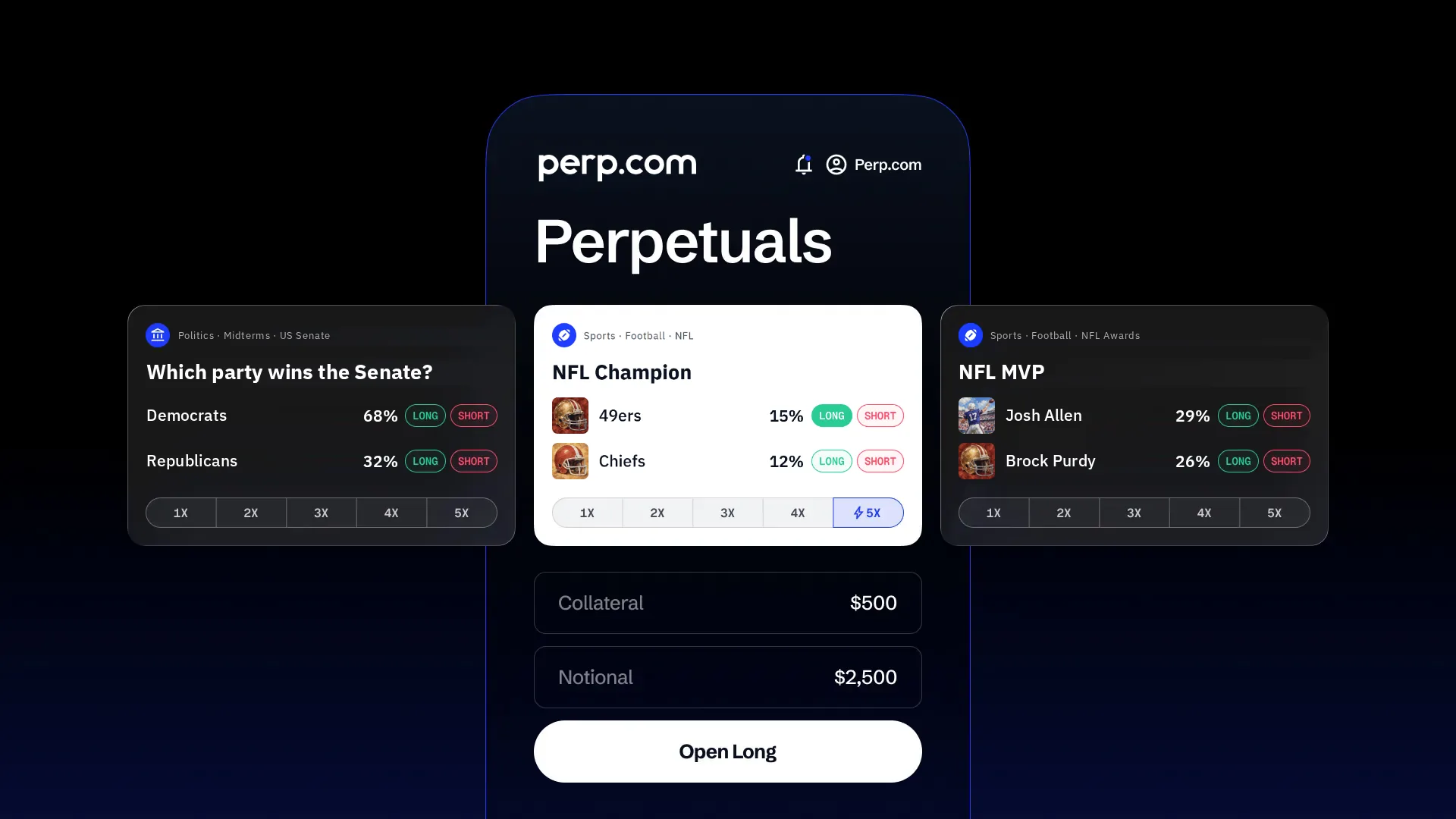
On Perp.com, every market is one outcome of a real-world event, and the price is the market's implied probability for it. A price of 0.35 means 35%. You go long if you think the odds are too low and short if you think they're too high. The price is bounded: it can't go below 0 or above 1, and it eventually resolves when the event is decided.
On PerpCity, a market tracks an index of real-world data that keeps updating. Its docs give examples like the real-time electricity price in New York City and Pump.fun's revenue. There is no yes-or-no outcome behind it and nothing resolves; it's a continuous number, settled in cash.
That difference shapes everything else. An event market can jump from 40% to 95% on one headline and has a natural end date. A data index moves with whatever it measures and has no built-in finish line.
Where the price comes from
Perp.com's mark price starts from Polymarket's odds for the same outcome. Before the risk system uses it, the feed passes through a guard pipeline: probability bounds that keep it strictly between 0 and 1, a per-update deviation clamp, smoothing, and a staleness check. Margin, profit and loss and liquidation all use the mark, not the last trade. The oracle docs cover each step.
PerpCity's prices come from its own oracle, Strobe Protocol, which its docs describe as using signed data, TLS proofs and computation proofs to attest to where an index value came from.
How trades are matched
Perp.com runs an order book. You can place limit, market, post-only, IOC, FOK and reduce-only orders. Fills are matched off-chain and settled on-chain on HyperEVM, with USDC collateral held in an on-chain vault. Takers pay 5 bps; resting maker liquidity is rebated or charged less.
PerpCity uses an automated market maker: trades execute against Uniswap v4 concentrated-liquidity pools on Arbitrum One rather than against resting orders. Its docs list an opening fee of about 1.1%.
Leverage, margin and funding
Perp.com offers leverage from 1× to 5× with cross or isolated margin. Its initial margin is dynamic: it rises with a market's open interest and as the event nears resolution, because event prices tend to jump late. Funding keeps the order book near the mark, with an 8-hour baseline interval scaled per market, and it is capped so funding alone can't force a liquidation.
PerpCity offers up to 10× leverage with isolated margin and USDC as margin. Its funding pulls the trading price toward the index.
Liquidation and backstops
On Perp.com, a position is liquidated when its equity reaches maintenance margin. Liquidation is partial and rate-limited, executes against the order book first, then uses auto-deleveraging for any remainder, with an on-chain Insurance Fund as the final backstop. The ADL docs set out the order.
PerpCity's docs describe an insurance pool as the first backstop, followed by ADL.
What happens at the end
Perp.com markets end when the event resolves. The market enters a settling window: the mark moves gradually toward 0 or 1, trading becomes reduce-only, and any position still open when the window ends closes at the final mark. The trading docs show the lifecycle.
A PerpCity index has no resolution event. Its perps are cash-settled against the index, so there is no yes-or-no answer for the price to converge to.
Which fits what you want
- If you have a view on whether something will happen, an election, a rate decision, a match, Perp.com's markets are built for that. Perps on prediction markets explains the model.
- If you have a view on how a real-world data series will move, such as a power price or an app's revenue, that's what PerpCity's index markets track.
Either way, leverage magnifies losses as well as gains. Read each venue's own documentation before trading, and size positions so a sharp move can't take more than you can afford to lose. For more options, see PerpCity alternatives.
FAQ
- What is PerpCity?
- PerpCity, built by Strobe Labs, offers cash-settled perpetual futures on data indices built from real-time internet data, such as NYC's real-time power price. It runs on Arbitrum One.
- Is PerpCity on Base or Arbitrum?
- Arbitrum One. Older descriptions call it a Base protocol, but PerpCity's own SDK changes from July 2026 state that the protocol runs on Arbitrum, not Base.
- Does PerpCity use prediction market odds?
- No. PerpCity's indices are built from real-time internet data through its Strobe Protocol oracle. Perp.com is the one whose mark price comes from Polymarket's odds.
- What is the main difference between Perp.com and PerpCity?
- What they track. Perp.com's perps track the probability of a real-world event, between 0 and 1. PerpCity's perps track continuous data indices with no event resolution.