Product
How Perp.com builds perps on Polymarket outcomes
Polymarket's perps trade asset prices. Perp.com's trade the outcomes themselves. Here is how that works, step by step.
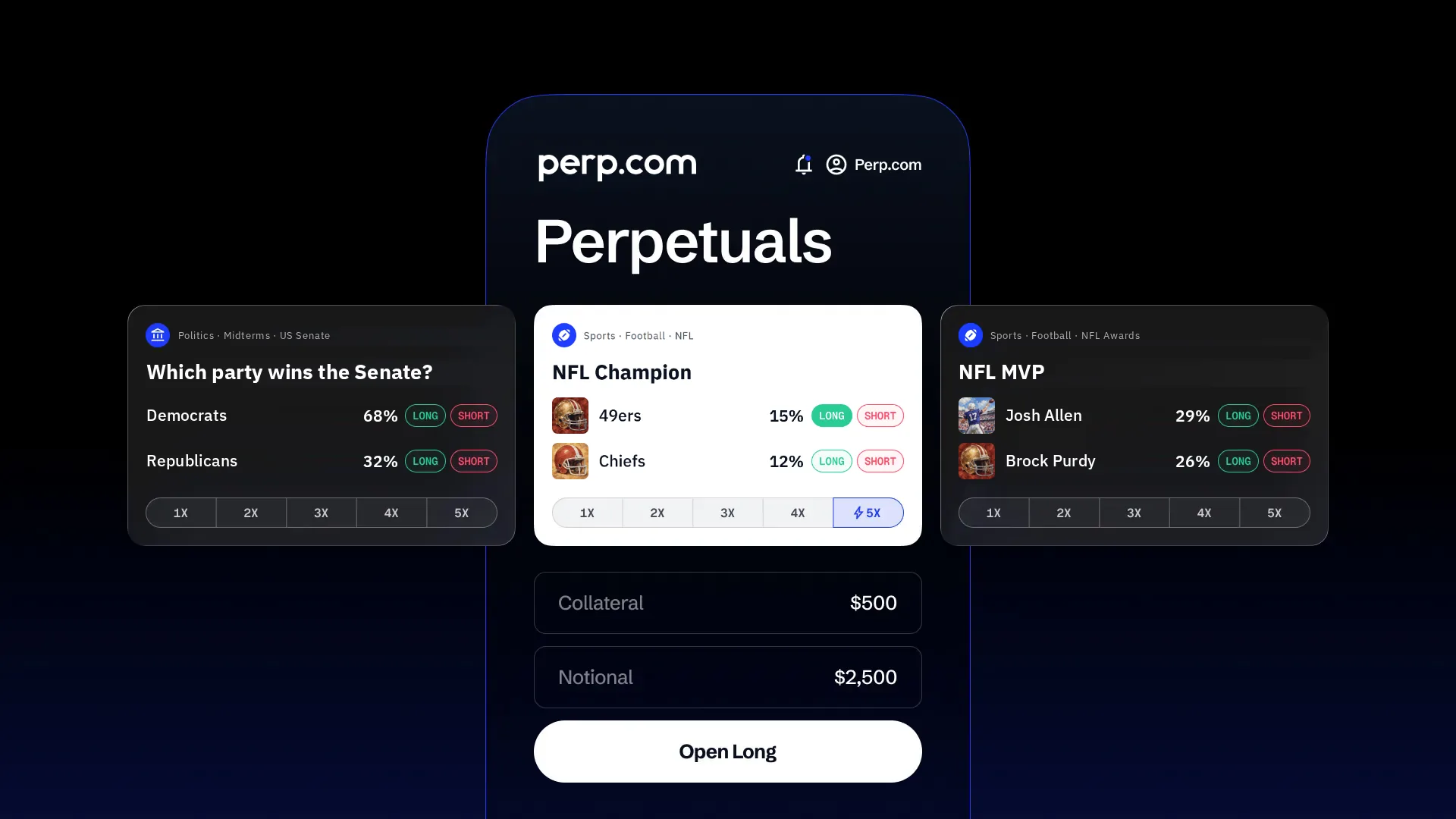
"Polymarket perps" now means two different things. Polymarket's own perpetual futures, launched in September 2026, are on crypto, equities, indices and commodities, and its docs say plainly that they have no event resolution and no $0/$1 settlement. Perp.com builds perps on the outcomes themselves: each market tracks Polymarket's odds for one outcome, and you can go long or short that probability with leverage from 1× to 5× and no expiry.
This article explains how Perp.com turns a Polymarket probability into a market you can trade with leverage: where the price comes from, how funding keeps the book honest, why margin changes as an event approaches, and what happens when the answer arrives.
Two things called Polymarket perps
Polymarket announced perps in April 2026 and launched them publicly on 3 September 2026. They offer up to 20× leverage (50× in the lowest tier, according to its API), are quoted in pUSD and settle on Polygon. Its perps FAQ puts the key point directly: "Perps are continuous: there is no event resolution and no $0/$1 settlement."
| Polymarket perps | Perp.com | |
|---|---|---|
| What a market tracks | Crypto, equity, index and commodity prices | The probability of one event outcome |
| Price range | Unbounded asset price | Between 0 and 1 |
| Event resolution | None | Settling window at resolution |
| Leverage | Up to 20× (50× lowest tier) | 1× to 5× |
| Collateral | pUSD | USDC |
| Settles on | Polygon | HyperEVM |
So if you're looking for leverage on whether something will happen, Polymarket's perps aren't that product. Perp.com's are. For a broader view of the options, see PerpCity alternatives.
Why outcomes need different plumbing
A crypto perp tracks a price with no ceiling and no end date. An outcome is different in three ways, and each one shapes the design.
- It is bounded. The price is a probability, between 0 and 1. Leverage math breaks down if the price sits exactly at either edge.
- It jumps. A probability can drift for weeks, then move from 40% to 95% on a single headline.
- It ends. Every event resolves, and the price has to land on 0 or 1.
A share on Polymarket handles this by being fully paid: you put up the whole price and wait. A leveraged contract can't, so Perp.com adds a guarded mark, funding, dynamic margin and a settling window. Perps on prediction markets gives the trader's view; what follows is the mechanism.
Step 1: one market, one Polymarket outcome
Each Perp.com market is a single event outcome, mapped to the Polymarket market whose price expresses the same outcome's implied probability. An Oracle Keeper pulls that price at a fixed cadence and bridges it onto HyperEVM through an oracle adapter registered on-chain.
That raw probability is never used directly for margin. It goes to the Mark Price Service first.
Step 2: turning odds into a mark
The mark price is what margin, equity, profit and loss and liquidation are measured against. To get there, the raw feed passes through four guards in order:
- Probability bounds clamp it strictly inside 0 and 1 while the market is live.
- A deviation clamp limits how far the mark can move in one update, rejecting feed spikes and manipulation.
- Smoothing averages the recent feed, removing per-tick jitter.
- A staleness check flags the feed if it stops updating, so the protocol falls back rather than marking on old data.
The pipeline produces two values: the mark, used by the risk system, and an index, which the funding engine compares the order book against. The guarded mark is also written on-chain, so the position and settlement contracts can verify margin and liquidations against it rather than taking the operator's word.
If Polymarket is unreachable or stale, the keeper holds the last good mark, flags it, and defers price-sensitive actions. The oracle docs cover each piece.
Step 3: an order book, anchored by funding
The mark comes from Polymarket, but trades happen on Perp.com's own order book, with limit, market, post-only, IOC, FOK and reduce-only orders. Takers pay 5 bps; resting maker liquidity is rebated or charged less.
The book is free to drift from the mark, so funding pulls it back. When the book trades above the mark, longs pay shorts; below it, shorts pay longs. The rate is built in three stages: a premium sample each block (the book's impact mid-price minus the index), a median of those samples each minute, and an average of the minute medians across the funding interval. The baseline interval is 8 hours, scaled per market and shorter for events that resolve within a day. The rate is capped so funding alone can't push a position into liquidation.
Step 4: margin that knows the calendar
Event risk grows as resolution approaches, so Perp.com's initial margin is dynamic. It rises with two inputs: a market's open interest, and how close the market is to resolving. Two identical orders can need different margin, and the effective requirement is returned at order time.
Once a position is open, equity is measured at the mark. If equity falls to maintenance margin, the position is liquidated. Liquidation is partial and rate-limited, executes against the order book first, then uses auto-deleveraging for any remainder, with an on-chain Insurance Fund as the final backstop. The ADL docs explain the order.
Step 5: a settling window instead of a cliff
A Polymarket share snaps to $1 or $0 when the outcome is decided. A leveraged position that gapped like that could skip straight past its liquidation point, so Perp.com resolves markets gradually:
- The event resolves and the market enters its settling window.
- The mark moves from its last value toward 0 or 1 over the window.
- Trading is reduce-only: you can close or shrink a position, but nobody can open new exposure.
- When the window ends, remaining positions close at the final mark and balances are released.
Where the money sits
Collateral is USDC, held on-chain in the CollateralVault. Orders are matched off-chain for speed, and fills are batched and settled on-chain on HyperEVM. Withdrawals pass through a delay window, during which a withdrawal can be rejected if it would leave your equity below requirements. The trading docs walk through the balance buckets and the market lifecycle.
A worked example
The numbers are illustrative. They assume each contract moves $1 for a full move from 0 to 1, like a Polymarket share, and ignore funding.
What this doesn't change
- The source odds matter. The mark follows Polymarket's price for the same outcome. If that market is thin or wrong, so is the mark.
- Leverage cuts both ways. At 5×, a move of a few probability points can take most of the margin behind a position. Leverage and liquidation shows where the line sits.
- Guards slow the mark, not the news. Smoothing and the deviation clamp filter noise; a real move still arrives.
Perp.com is in closed beta, selecting 15 traders a week from people who show up on its posts on X. You can browse the markets now.
FAQ
- Can you trade Polymarket outcomes with leverage?
- Polymarket shares are fully paid. Perp.com offers perpetual futures that track Polymarket's odds for the same outcome, long or short, with leverage from 1× to 5× and no expiry.
- Are Polymarket perps on prediction market outcomes?
- No. Polymarket's perps, launched in September 2026, are on crypto, equities, indices and commodities. Its docs say they have no event resolution and no $0/$1 settlement.
- Does Perp.com use Polymarket's price directly?
- Not directly. Polymarket's odds pass through a guard pipeline of probability bounds, a deviation clamp, smoothing and a staleness check before becoming the mark used for margin and PnL.
- What happens to a Perp.com position when the Polymarket event resolves?
- The market enters a settling window. The mark moves gradually toward 0 or 1, trading is reduce-only, and positions still open when the window ends close at the final mark.